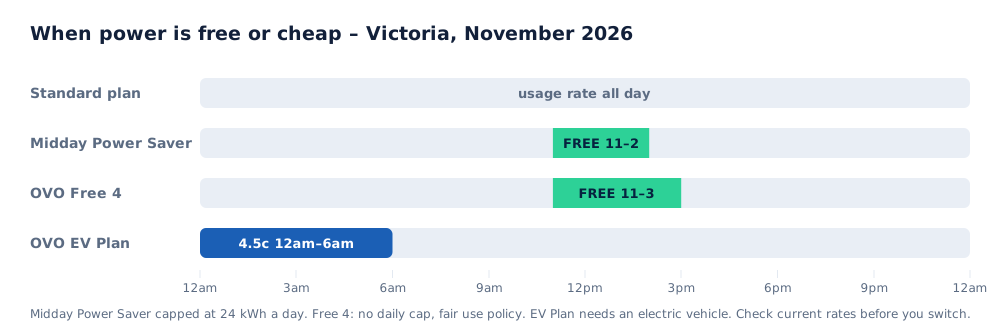
The rule: if everything you want to shift fits into 4 hours at your charging speed, Free 4 wins. If it doesn't – a big battery on a slow inverter, a car that's never home at midday, heavy winter heating – the EV Plan's 6 hours at 4.5c win.
Per kWh, free beats 4.5c by 4.5c. That's only about $328 a year on 20 kWh a day. The bigger difference is how much each plan lets you shift, and whether you're even allowed on it: the EV Plan needs an electric vehicle, Free 4 only needs a smart meter.
Five homes, worked out
Daily saving compared with paying 34c/kWh for the same power. Battery losses of 10% included.
| Home | Free 4 / day | EV Plan / day | Better |
|---|---|---|---|
| No EV, 13.5 kWh battery, 5 kW charging, 12 kWh used at night | $4.08 | not eligible | Free 4 – the EV Plan needs an EV |
| Works from home, EV home at midday, no battery (7 kWh a day for the car + 3 kWh of washing and dishes moved to midday) | $3.40 | $2.07 | Free 4 |
| Commuter EV away all day, no battery (7 kWh a day) | $0.68 | $2.07 | EV Plan – Free 4 only helps on weekends |
| Commuter EV + 13.5 kWh battery at 5 kW (12 kWh house + 7 kWh car at night) | $6.12 | $5.55 | Close – Free 4 slightly ahead |
| Big all-electric home: 50 kWh battery, 8 kW inverter, 45 kWh needed outside the cheap hours | $9.79 | $12.53 | EV Plan – 4 hours at 8 kW isn’t enough |
Multiply by 365 for a year: the big home is about $999 a year better off on the EV Plan; the work-from-home EV about $487 better off on Free 4.
A real one: my house
I'm on the EV Plan. The house runs a 50 kWh battery through an 8 kW hybrid inverter and uses about 60 kWh on a winter day. In Free 4's 4 hours, 8 kW puts about 32 kWh into the battery – not enough. In the EV Plan's 6 hours it's about 48 kWh, which covers the evening and night. If I had a 10–13 kWh battery and the car at home at lunchtime, I'd be on Free 4.
Things that change the answer
- Rates outside the window. Both plans charge normal rates the rest of the day, and those can differ. OVO quotes them by address; get both quotes and compare the whole bill.
- Your supply. On single-phase, keep long charging loads to about 50 A – see how much you can charge overnight.
- Solar. On Free 4 your midday solar mostly gets exported at a low feed-in tariff, so some of the saving is solar you'd have used anyway.
- Fair use. Free 4 has no daily cap, but OVO can move very heavy users to its standard contract.
- Switching is easy. No lock-in contract, so you can sit on the EV Plan in winter and Free 4 in summer if the numbers say so.
Full tables for every inverter and charger size: OVO Free 4 vs EV Plan – what each can save.