Short answer: on a typical 63 A single-phase supply, plan on about 50 A (about 11.5 kW) for loads that run for hours, like a car and a battery charging together overnight. That's 80% of the main switch. Over 6 cheap hours it's about 69 kWh; over the 4 free hours of a Free 4 plan, about 46 kWh.
Why 80% and not 100%
A kettle pulling 10 A for three minutes is nothing. A car charger pulling 32 A for six hours straight is different: the cable, the main switch and every screw terminal in between warm up and stay warm. A slightly loose terminal that never causes trouble with short loads can run hot under a long one. That's where most switchboard heat damage starts.
Keeping long loads to about 80% of the main switch rating leaves room for the things you don't plan – the oven, a heater someone switches on, the hot water kicking in. It's a common rule of thumb in electrical design for continuous loads. It isn't a number written into Victorian law. In Victoria a 32 A single-phase EV charger is allowed, and your electrician works out the maximum demand for your home under the wiring rules before installing it.
What fits under 50 A
Rough current draw at 230 V for common overnight loads:
| Load | Power | Current |
|---|---|---|
| EV charger, 7 kW (32 A) | 7.4 kW | 32 A |
| EV charger turned down to 16 A | 3.7 kW | 16 A |
| Battery charging at 5 kW | 5 kW | 22 A |
| Battery charging at 8 kW | 8 kW | 35 A |
| Three bedroom split systems heating | 3 kW | 13 A |
| Fridge, freezer, standby, pool pump on timer | 0.6 kW | 3 A |
And what happens when they run together:
| Running at the same time | Total | Verdict | Fix |
|---|---|---|---|
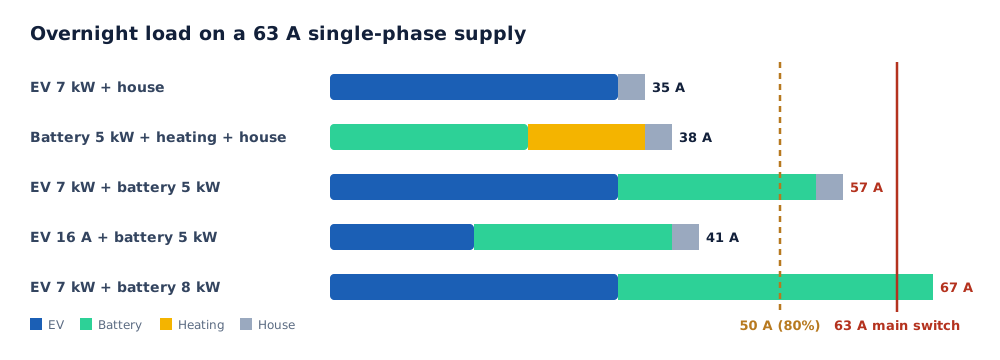
| EV 7 kW + background loads | 35 A | OK – under 50 A | Fine on its own |
| Battery 5 kW + heating + background | 38 A | OK – under 50 A | Fine |
| EV 7 kW + battery 5 kW + background | 57 A | Over 50 A – stagger or turn something down | Charge the car 12–3am and the battery 3–6am |
| EV 7 kW + battery 8 kW | 67 A | Over the 63 A main switch | Stagger them, or turn the car down to 16 A |
| EV turned down to 16 A + battery 5 kW + background | 41 A | OK – under 50 A | Fine – the car still adds about 22 kWh in 6 hours |
| Same, plus heating in all three bedrooms | 54 A | Over 50 A – stagger or turn something down | Finish the battery by 3am, or set the battery to 3 kW |
Easy ways to stay under it
- Stagger the windows. Car first, battery second (or the other way round). Most EV apps and battery apps let you set start and stop times.
- Turn the car down. Most chargers and cars let you set the charging current. At 16 A a car still adds about 22 kWh between midnight and 6am – around 140 km.
- Load management. Many chargers and hybrid inverters have a current sensor on the mains that throttles charging when the house load goes up. Ask for it at install time; it's cheap insurance.
- Get the switchboard checked. Long overnight charging is a good reason to have an electrician check and tighten the main switch and terminals, especially in older boards.
What this means for cheap-rate plans
A tariff can give you free or 4.5c power, but your supply decides how much you can actually take. On single-phase at 50 A, that's about 46 kWh in the 4 free hours of OVO's Free 4 Plan and about 69 kWh in the 6 hours of its EV Plan – before the house uses any. If you need more than that, the choices are a three-phase upgrade or a plan with a longer cheap window. See Free 4 or EV Plan: which is better.
General information, not electrical advice. Your installer's maximum demand calculation for your home is what counts.